Showing posts with label this world. Show all posts

Saturday, September 27, 2014

new moon sky duality + a larger universe

for sky friday: a fascinating sunrise, which looked like 2 skies in one. reality, so surreal sometimes. i guess the effect was caused by morning mist that still lingered in the forest.
the first photo is from 6.48:


and this is just 15 minutes later, with the sun rising:


*

and a  different kind of sky moment: this week, the tv channel arte featured a docu about CERN  centre, where scientists try to figure out how our universe works. it was fascinating, and for once a docu that took its time, visited different places in CERN and gave an idea of the place and the people who work there. it's online here: Cern. and yes, it starts almost meditative, and multilingual. the interviews are in English ("the common language at Cern is broken English", states the scientist in the first inteview), the subtitles are in German, and the intro page of the docu is German/French..


Watching it made me think of my own Cern moment 2 years ago, at the Frankfurt Bookfair, where to my surprise, between all the book stands, Cern was present with an experimental stand. They had a medialab that visualized the Higgs Field.

And they had something else: the beginning of the internet. which started in Cern, with the first internet server of the world installed there, and with the original internet project proposal: the "Information Management" proposal of Tim Berners-Lee. The proposal has a pencilled note on top that says: “vague but exciting”. 

Seen like this, searching for the tiny particles that explain the universe, the scientists there opened the digital sky.


Here's more, in the blog post from the bookfair: "the beginning of the web" 

*

More skies in this blog: life as a journey with changing skies
More skies from everywhere: skywatch friday


have a beautiful sky week ~

Wednesday, September 17, 2014

links that touched me: September 2014


When I come across an interesting link / video / story that touches me, I often copy the link to blog about it at a later point. Yet by then, there's already another interesting link that is waiting... to keep the links from vanishing unblogged, I started this "links-that-touched-me" series. Here's the next part:

Previous links:
- August 2014: the art of fiction, NY, Maya Angelou..
- July 2014: look in the mirror, 61 things...
- June 2014: travel is, Slowalk, real words
- May 2014: Perspectives, ISS, Poetry Storehouse
- March 2014: Kerouac, shipping yard, film fatales,Hiding, Guardian Film Show
- February 2014: transforming problems, noticing thejourney, poetry podcast
- January 2014: stop saying, when i was, worstpasswords, windows, why dieting....

Friday, September 5, 2014

Violence, the world, "violent" links, and a new blue "bomb" in the supermarket


Watching the news these days is difficult. So many tragedies, the Middle East and Ukraine and Ebola, and all the small dramas that happen close and far. And the brutality of it. It feels, all this shouldn’t be happening, that mankind was on a more peaceful path at the milliennium, and got all off the path. 
But then, looking at the larger timeline, Europe for a long time was going through the violence that now is shadowing the Middle East. And maybe mankind at its core isn’t really a species that opts for the peaceful paths.
Still. There is all this technology and knowledge, and shouldn't we learn at some point? And is it helpful to show and watch the pictures of violence and of its effects, in the amount that is continually present in the news, and where does all this violence come from? 

I don't have the answers, but in the last week, it was a theme that was in my mind, and either there are more articles about it, or I noticed them more than before. Here are some "violent" links: 
  • What are all these violent images doing to us? - a blog post from a journalist, which includes this link in the comments: Tragedies & Journalists: "A 40-page guide to help journalists, photojournalists and editors report on violence while protecting both victims and themselves."
  • Coursera has a new course up, which is about violence. Started by a nurse, who was faced with violence and the injuries it caused - and who looked for patterns of violence, and for ways to prevent it:
    "Understanding Violence: Violence is among the top three leading causes of injury and death in the US and globally. We will focus on different disciplinary approaches and perspectives to understanding and potentially preventing violence."
    I watched the first parts, it’s approaching the theme both on a personal and global level, and is presented by two instructors and additional experts, which also adds to the broader view of this complex theme. 
  • Watch as 1000 years of European borders change timelapse map that shows how European borders have changed over the last 1000 years. and the maps don't say it, but probably most of the changes were the result of wars, or acts of violence  
Ironically, when I went shopping, I walked past the shelf with energy drinks, and even there the theme was present: "Bomba" is a new energy drink, which picks up the mood of the world, it seems.

Peace ~

Monday, August 19, 2013

"Where do we go from here?" - reading: Jane Austen in Baghdad, self-discovery in France, holidays & wars, and more

This blog post is inspired by the general joy of reading, the 7 continents reading challenge, and a blog series. More, at the bottom of this post.


Last week brought some world-reading, with a book that leads from UK to Baghdad, and one that leads from Germany to France.... both dealing with the large questions of life: "How to go on?"


Talking about Jane Austen in Baghdad
This book is about an unusual mail friendship between women who live in very different hemisphere and circumstances: it starts when BBC journalist Bee Rowlatt looked for citizens in Baghdad in 2007 to interview about their situation and how daily life can go in a time of invasion, with its difficult, war-ridden circumstances. and one of the persons she interviews is from the university: May Witwit, a lecturer of English – and from that interview, a mail dialogue develops that leads through years.  

Reading through the ongoing mail conversation, I also kept thinking of the situation in Iraq now, and of Egypt and Syria: so many families are trapped in those places of turmoil, hoping things will return to peace, and wishing they had fled earlier, and just stuck there, in a world that turned upside down, where shops close, where streets are blocked, where justice and security and normality walked away. The mails from May are contrasted by Bee’s mail from UK, who talks about the life there. And when reading, is also contrasted by my own life. The way I can drive to places, access the internet, be able to go jogging, or go for a walk, a life that comes with problems and frustrations, too, and illness and dramas, but on a very different level. 
Here's the Goodreads-link to the book.


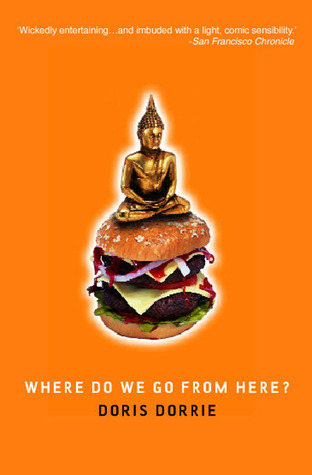
Where do we go from here?
This is one of the chance books I wouldn't have picked myself, but it stood there in the telephone box book exchange - it's from Doris Dörrie, the German filmmaker with the “Hamami” film that is set in Japan. And just like the Hamami film, this book deals with the big life questions: how to deal with life, our dreams, and the reality that sometimes leaves us stuck in situations that seem like a self-created knot.  What when we don't feel at home in the life we created for ourselves? 

Writing this, I just noticed this parallel to Hamami: that the story starts in the West, but leads to the "East", in this book: to a buddhist retreat in France which is key to the story.

I just wished they had given the book a different cover than the one with the chic dancing couple in the photo above. Yet when I saw the English edition, I had to smile: it looks like a different novel, but also doesn't really catch the book and its mood. Here's the book description, and mostly, this really is a humorous and thoughtful journey of self-discovery that takes the reader along the way.

Meet Fred Kaufmann, disillusioned husband of thoroughly competent Claudia and father of surly teenager Franka. His dreams of being a movie director have long ago been shelved for marriage and a child. While Claudia sells her successful vegetarian take-out restaurant to a fast food chain and buys into Buddhism, Fred is trapped in the throes of a classic midlife crisis, made worse when Franka falls madly in love with a young guru. With the hope that brown rice and hardcore meditation will cure Franka's obsession, Fred chaperones his daughter to the meditation center in the South of France. But as a bizarre set of events unfolds, he embarks on a journey of self-discovery that only a special kind of hero can survive. Funny, incisive, and ultimately forgiving, "Where Do We Go From Here?" is a masterpiece of ironic social comedy from one of Germany's leading writers and filmmakers. (the book at Goodreads)

**

Holidays, borders, war & this world
From books to film and to the news: the theme of the two worlds in "Austen in Baghdad" continued after I read the book, in a film that was featured in TV: “The Color of the Ocean”. The film tells the parallel storis of  boat migrants from Africa who try to make it to the Canary islands, and of a tourist who is trying to help when they are washed ashore. The contact creates a difficult connection between those worlds, and shows the twisted identity of the shore as both a holiday-bath-in-the-sun place, and a dangerous crossing line into Europe. Here’s the film page with trailer: http://www.diefarbedesozeans.de/

While reading the Baghdad book, the situation in Egypt got worse, and on Friday, the German travel agencies announced that all upcoming package journeys are cancelled until September. It was one of the main news items of that day, as Egypt still is well-visited from Europe. So you had the bizarre combination of news from Kairo with the almost civil-war-like scenes, and the death toll of 500 and rising. And then you had the travel warning, and frustrated families at the airport who had to go back home instead of boarding their holiday flight. Which, thinking of it in relation to the people who live in Cairo and what they are going through, isn’t really a drama.

Watching the reports, it seemed like 2 views on one place, one from inside as citizen, and one from the “but-we-want-our-summer-holiday-as-planned”-view. But i guess this is how the human mind works, that we see the world through the filter of our life, and that books like Austen in Baghdad help to show a view that you seldom see in the news: the difficult everyday life of people trapped in an occupied zone. 

**

France & Finding Books

Upcoming... when all works out, I will heading to France next week, and I am currently figuring out which book to take along - will blog about them before leaving. I really enjoy this literal discovery-tour of the world. For some helpful resoursec, try this list of links that i pieced together earlier this year: Finding books by country: helpful links + resources


*****
Previous reading blog entries are collected here: bookshelf: currently  reading... there also is a visual bookshelf, just click it to get there.

Around the world is a challenge by book blogger Giraffe Days. Here's the challenge overview link, and here the Belgium reading challenge page.

More monday reads from other bloggers: link list at book journey

And my own new book... is Worl(d)s Apart. True.


Monday, July 22, 2013

Reading: Memory Novel + Travel Essays + "Light in August"

This blog post is inspired by the general joy of global reading, the local library, a blog series, roads, and an online lit course. More, at the bottom of this post.


A library book and a suggested read: this week's reads lead from a wonderfu/painful novel about life and memory back to a classic. Also, it brought some travel essays:

A Memory Novel: "Still Alice" by Lisa Genova
Another wonderful surprise find in the library: I was drawn to "Still Alice" by its blue cover and the short description: the story of a woman who is loosing her memory and is dealing with it by focusing on the now. that’s what i read on the cover and back of the book. they didn’t include the word “Alzheimer” - but that’s the core of the story. The author – just like the main character Alice – is working in Neuroscience at Harvard University.

It’s a touching book, which makes it graspable how it feels to have this terrible disease, and the problems and situations that come with it. It also shows the grey zone of doubt - what is still normal when it comes to mistakes and forgetting things, and where does the illness begin? And it includes this painful angle: as a person who reads and writes, and whose literacy is part of her identity, how do you deal with the fact that you aren't able to grasp longer sentences again? That you can't read books, are overwhelmed by conversations? This drama: all those things we learn as child: the a-z of life, fading again.

In some ways, it's also the counterpart to the Memory Learning book I read earlier this year, with memorizing techniques: A Memory Guide

And here's the introduction to "Still Alice", from the book blog, in it the author Lisa Genova also tells the story of the book itself: “I graduated valedictorian with a BS in Biopsychology from Bates College and have a Ph.D. in Neuroscience from Harvard University. Trading in my pipette for a pen, I wrote my first novel, "Still Alice", about a 50-year-old Harvard professor who develops young onset Alzheimer's Disease. Originally self-published because I couldn't find a literary agent to represent it, "Still Alice" was eventually bought by Simon & Schuster and debuted at #5 on the New York Times Bestseller list.

*


Travel essays

The travel blog "I Must Be Off!" organized its its first annual Travel Essay Contest. More than 80 travel essays went online, from destinations all over the world.

Now the winners have been announced - i put a feature together in the blueprint lit blog for them, to help to spread the word: Travel Essay Competition

This weekend, I also read the winning entries and the recommended reads, which lead from Asia to Europe and back again. One of my own favourites is 
“Rock, Paper, Scissors”, a story that reminded me of my own time in Cambodia.


**

"Light in August" by William Faulkner
"A novel about hopeful perseverance in the face of mortality", this is the next suggested read for the "Fiction in Relationships Class" (more about that, here: Literary online course), and together with Virginia Woolf's "To the Lighthouse" and Charlotte Bronte's "Jane Eyre, another "big" classic. Before starting, I looked for online material - and found this description, and two moving clips:

"In a loose, unstructured modernist narrative style that draws from Christian allegory and oral storytelling, Faulkner explores themes of race, sex, class and religion in the American South. By focusing on characters that are misfits, outcasts, or are otherwise marginalized in their community, he portrays the clash of alienated individuals against a Puritanical, prejudiced rural society. Early reception of the novel was mixed, with some reviewers critical of Faulkner's style and subject matter. However, over time, the novel has come to be considered one of the most important literary works by Faulkner and one of the best English-language novels of the 20th century."

Here are the first pages, in a video read:


And here's a summary in a video clip. Seeing it, I was moved - by the theme of the book, by the ones who made this clip.


Upcoming reads for this week...will be from the graphic novel front: visiting the Eisner Award winners.


*****

Book Links, Previous Reads & Finding Books


Previous reading blog entries are collected here: bookshelf: currently  reading... there also is a visual bookshelf, just click it to get there.

Reading around the world - i really enjoy this literal discovery-tour of the world, and it now made me go and pull some useful links together in a blog post: Finding books by country: helpful links + resources

More monday reads from other bloggers: link list at book journey

And my own book... is Worl(d)s Apart. True.

Monday, May 20, 2013

Finding books by country: helpful links + resources


How to find books set in particular countries? 
And more so, preferably books that are written by an author who is coming from the country, or who has lived in it for a while? There are so many book lists and blogs out there, yet many are focusing on sales figures or author names or genre. But there are also some lists that focus on the country:

Wikipedia + Goodreads
Both Goodreads and Wikipedia have feature pages that lead to many subpages:
**

Nobel Prize & Man Asia Prize 
And of course, there is the Nobel Prize in Literature, with countries noted: 
Specifically for noteworthy current Asian literature, the Man Asian Literary Prize offers longlists and shortlists of nominated books, each entry with book descriptions and author bios:
**

Magazine Issues
There are also some liteary magazines that have issues with a special focus on one country, which probably is a good way to explore various authors and the current atmosphere:
**

Blogs, websites, lists, links
Reading around the whole world in books and blogging or writing about it - that's where the following links are from:

Blogs
Websites
**

Searching for a place in an e-reader
If you have an e-reader, it might be interesting to run a search there: e-book readers can neatly look for a word in all e-books they have in their files, and create a neat sorted list with bookmarks.


**

More links
If you know an interesting world-book-link, feel free to add it in the comments.


**

Global Reading & The Danger of a Single Story
This post belongs to the global reading challenge "7 Continents, 7 Billion People, 7 Books". In addition to the links, a video clip:  reflections by Nigerian novelist Chimamanda Adichie on single points of views and the prejudices they invite, and on world literature:


Saturday, March 30, 2013

Fascinating info graphic: The World as 100 People


Via twitter, i arrived at a fascinating info graphic that shows a multitude of aspects of the world population in one single circle. Above, a piece of the circle, and here's the whole infographic: The World as 100 People

Last year i searched for a graphic like this when i ran looked at the continents of the world, and the sum of all people living on this planet (7 million), and wondered how you would read around the world when following a population-per-continent-ratio. Which lead to this own info graphic: World Population by Continents


What i didn't know back then - or maybe it wasn't up there yet, or not showing easily in google searches - is that there's a research project on the world / 100 people topic, with a large online page. That's where the date of "the world as 100 people" is from. here's the link: 100 People: A World Portrait

And here's a line from the intro page, on education: "In 2006, only 1 person out of 100 would have had a college education-- today that number has jumped to 7 thanks in part to advances in higher education in Asia."

World Links
And two more world links: An optimistic Ted Talk on world poverty statistics: Bono: Yes there's good news + Hans Rosling: The good news of the decade?

Saturday, February 23, 2013

The Ing-ness of Living at Indie Author TV + 5 world links


Indie Authors TV is featuring several indie book clips - one of them is "The Ing-ness of Living", an excerpt of the "Worl(d)s Apart" book i wrote with Smitha Murthy. Jessi Graustein at Folded Word has created this moving journey clip: Worl(d)s Apart at Indie TV

More about the book, here: Worl(d)s Apart

+  5 world links from this week

Saturday, January 19, 2013

skywatch views from around the globe & 3 world links


"A place to enjoy skies and views from all around the globe. Skywatch is only as good as the people who post here. It is a "not for profit, not for awards" fun place to post and link from."

that is Skywatch. it is ongoing since 6 seasons. i only found it recently. to join, simply take a picture which includes the Sky, post that picture on your blog and then go there to add your sky.
i just added this week's small stone sky collage, which now is part of the larger automatic skywatch collage of more than 160 skies.

**

& 3 world links:

Thursday, November 22, 2012

Monday, November 5, 2012

Little World, Left Hand of Darkness & My Life (in 37*37 sentences), or: what are you reading?


Big Backpack, Little World (a chance encounter)
So many places in this world, and so many books - the eternal question probably is: from the million of possibilities, how to figure out the journeys to take, and the books to read? Just try it, is one option. That's how I came across the travel memoir "Big Backpack, Little World", which happened to be free for the day just when I checked the e-book travel listing. So glad I ordered it:

"Big Backpack, Little World" is a fine read - a travel memoir by Donna Morang, who lived in Montana and Alaska. After retirement, she decides that she is ready to try something new again, and starts backpacking and teaching English abroad. She has a wonderful humour and a perspective of someone who has seen a lot already, and at the same time is open and excited about life, and keeps learning herself. It's a joy to follow her trails to Mexico, Spain and Cambodia, and made me also think of my own days of solo traveling in other countries. As starting point, I'd recommend her blog updates from Mexico, which have the same warm touch as her book: ESL Donna

The Left Hand of Darkness (a modern classic)
A modern classic, and the second book ever that won both the prestigious Hugo Award and the Nebula Award: that's "The Left Hand of Darkness" by Ursula K. Le Guin. It's labeled science fiction, but in the introduction Le Guin suggests to read it rather as a thought-experiment: not as a future prediction, but as a story that describes reality, the present world, "a truth - wrapped in fiction". The story itself has the form a of journal or a travel report. It starts with the words: "I'll make my report as if I told a story, for I was taught as a child on my homeworld that Truth is a matter of the imagination..."    

On first glance, a very different book than "Little World", but both books are about getting in touch with the previous unknown, and sharing knowledge with people that live in a different place, in a different kind of society, and who speak another language (and then with the reader). The traveling in Le Guin's book has a much larger dimension, though - it's to another world, a world named Winter, as messenger. Here's a quote that gives an idea of the concept, which was informed by Le Guin's family, too: both her parents were anthropologists, and the theme of cultural encounters runs through her book:

"Alone, I cannot change your world. But I can be changed by it. Alone, I must listen, as well as speak. Alone, the relationship I finally make, if I make one, is not impersonal: it is individual. Not We and They, not I and It, but I and Thou." 

Beyond the book: Wired Interview and a literary course
Le Guin is over 80 now, and still giving fascinating interviews - WIRED spoke with her last year, they have the talk up on their page both as transcript with images and as podcast: Still Battling the Powers That Be

And here's a short interview that is moving - Le Guin about life, age, books in time, and being an author:


For some background information of the book, you can check out the online literary class of Eric Rabkin at Michigan University, several video lectures are dedicated to Le Guin's book (here's the course link: English literature: Fantasy and Science Fiction, The Human Mind, Our Modern World.


"My Life" by Lyn Hejinian, and "My Emily Dickinson" by Susan Howe 
I am still following the "ModPo" Modern Poetry Class, and it's like a guided tour through modern poetry with a lot of reading samples. Interesting also how the themes of this week connect: from the traditional travel memoir of Small World, to "My Life" by Lyn Hejinian, who created an experimental biography, written at age 37 in 37 segments of 37 sentences each, and later, at age 45, revised into 45 segments of 45 segments each - by format itself already a reflection on the nature of life and memory. Here are 4 sentences from one of the childhood segments: 

"A pause, a rose, something on paper. Solitude was the essential companion. The branches of the redwood trees hung in a fog whose moisture they absorbed. Lasting, "what might be," its present a future, like the life of a child."

And - Susan Howe, and her writing that is sparked by Emily Dickinson, especially by her poem #754. Reading it is a reminder again of the power of words that still stand on a page, that remain, that are an open side of a dialogue waiting for a reader, long after the writer has gone.
The starting lines of said poem #754, one of those that still echo from the reading:

"My Life had stood - a Loaded Gun - 
In Corners - till a Day.."

For more, try this google link. It leads to 1.750.000 pages loaded with words - quotes, notes and responses to a poet unforgotten.

****

It's Monday! What are you reading? This blog post is inspired by the blog series "It's Monday! What are you reading?" which is hosted by Sheila at Book Journey. participating blogs are listed in this Linky Book List

Previous reading blog entries are collected here: bookshelf + monday reads. there also is a visual bookshelf, just click it to get there:


Some lines about me: I'm into roads, stories, places, crossings, and all the things they lead and connect to. I edit BluePrintReview and the blueprint book + lit blog. Apart from being an editor and blogger, I am also an author myself. My new book Worlds Apart launched some weeks ago:

Worlds Apart: the true story of 2 friends, 2 journeys, and 10 life lessons  
In the global world, a traveler from Europe and a teacher from Asia meet in the web, share their journeys, and the joys, longings, and life lessons that wait along the road. Captured in letters and photos that reach from China and India to Germany and the Mediterranean Sea, a dialogue across continents and cultures unfolds: Worl(d)s Apart

Sunday, October 14, 2012

gravitation in motion, or: a larger universe

inspired by photo friday "in motion"


my body in the Higgs Field:
"now think gravitation," the scientist says
and physics go pop

**

the science photo is from the book fair - the international science lab CERN has an installation there in the hall with science books, and they visualize the Higgs Field - something all abstract to me until that point, and stepping into the field visualizer now actually made me go and listen to some youtube clips about it, like this one that gives a 2-minute-idea of the larger frame of our universe and how the higgs-field and the particle discovered at CERN this year fits in / opens up the universal theories: Higsgs/God Particle explained.
(there's also a written explanation in the video note)

here's a larger view of the installation:


the Cern scientists also brought the first www-server along. remember the olympics ceremony with the scientiest Tim Berners-Lee twittering "This is for everyone"? here's his original proposol of the web: "the beginning of the web: vague but exciting"

and here's the Cern info: Bringing particle physics to the Frankfurt Book Fair

and i think i am turning into a geek. oh well.

**
photo friday and links

and here, the link to photo friday. to join, just blog a photo and add the link

some interesting blogs and motions from fellow bloggers  i came across this time:

Friday, October 12, 2012

the beginning of the web: "vague but exciting"

A surprise guest at the International Book Fair Frankfurt:
in the hall 4.2 with the science and education books, there is: CERN


with a desk of current publications,
but that's just the minor part of their presentation

their new "medialab" department created 2 installations:
one is a visualization of the "Higgs Field"
(that's the higgs-version of me, to the right, taking the photo)


"And we have something else," one of the CERN crew said:
"The first web server of the world, from Tim Berners-Lee”. 

it’s the one that i recently saw in the Coursera course about "Internet History and Technology" 
by Charles "Chuck" Severance, who had interviewed Berners-Lee, and who also

talked about visiting CERN in the course.


Together with the computer, they had a copy of the original "Information Management" proposal of Tim Berners-Lee. The proposal has a pencilled note on top that says: “vague but exciting” 


Pretty cool to see this. There even is the term "Hypertext" included in the proposal.
I took a photo with the mobile phone, and posted a first photo with blog-per-email.

**

there's a separate post with
(those are a bit more of the bookish kind)

and one more photo- i just remembered taking it:
this is from the final lesson of the Internet course,
a wrap-up lesson with reflections and demographics,
including a world map with course participants.
(more in Dr. Chuck's Blog)

so exciting, indeed.


Saturday, September 29, 2012

This week: The revolution brought by writing, The purpose of art & The poet's task


"A poem is a machine made of words" - Williams

Week 3 of ModPo, or: a larger image 
Week 3 of the online course ModPo (Modern & Contemporary American Poetry) is coming to conclusion. So glad i joined this courses, which became a daily practice by now - to read the next poem, to listen to the video discussion, to visit the forum.

In the current week, the main theme was the rise of Poetic Modernism, and with it, the course discussed formats as different as Ezra Pounds haiku-like 2-liner "In a Station of a Metro" and the classic modernist poem of William Carlos Williams: "The Red Wheelbarrow" that starts with the words / key: "so much depends / upon"

Also, for the first time the course visited and discussed 2 artworks: Marcel Duchamp's ready-made "Fountain" and his modernist painting "Nude Descending a Staircase"

Such a wide circle of thought - especially with the meta-level of modernism, and the way the poems address the idea of writing, which leads to general discussions of poetry, art, the artist's task.

The great thing about the course is that it leads through all those selected poems & poets & angles & artworks & reflections, while providing a string that is easy to follow and that cross-connects all those different works and thus provides the approach to the the larger picture -- the first two weeks formed the base, it feels, with their focus on Whitman and Dickinson, who both challenged the official verse culture, each in their own way, and the step from there to other "challengers": William Carlos Williams and the beat poet Allen Ginsberg.

Two quotes i want to keep from this week: the one at the start, "A poem is a machine made of words."

And this one, on art and the meta-nature of it, from the ModPo discussion on the Fountain:

"The purpose of art is to think about what art is." 

**

The revolution brought by writing
In almost perfect timing, the book i happened to start to read in September, and which by now became a daily habit, too - "A History of the World in 100 Objects" - arrived this week at the theme of, yes: Writing. Or to say it with the object that delivers the theme: "Early Writing Tablet". Made of clay, it its, found in Southern Iraq, and dating back to 3100 B.C.

The chapter starts with the words: "Imagine a world without writing - without any writing at all."

Here's a photo of the page, and below the central quote by John Searle, Professor of Philosophy at the University of California, Berkeley.


"Writig is essential for the creation of what we think of as human civilisation. It has a creative capacity that may not even have been intended. .. I think you don't understand the full import of the revolution brought by writing if you think of it just as preserving information into the future. There are two areas where writing makes an absolutely decisive difference to the whole history of the human species. 
One area is complex thought. There's a limit to what you can do with the spoken word. You cannot really do higher mathematics or even more complex forms of philosophical argument, unless you have some way of writing it down and scanning it.
So it's not adequate to think of writing just as a way of recording, for the future, facts about the past and the present. On the contrary, it is immensely creative. But now a second thing about writing, which I think is just as important as that, and that is when you write down you don't just record what already exists, but there are elements in which you create new entities. You create money, you create corporations, you create governments, you create complex forms of society, and writing is essential for all of that." - 

- Which, of course, also goes for online university courses and histories of the world.

Looking for the quote, i just discovered that all episodes of the book are up as online podcasts and transcripts, here's the one on the Writing Tablet: A History of the World - Transcript of Episode 15

There's more about ModPo & the 100Objects book in a previous post: 70 Days of Poetry with 30.000 Others + a History of the World in 100 Objects


Upcoming: Gertrude Stein and the awareness of the way words work

The next week in ModPo will focus on Gertrude Stein, which feels like the perfect next turn from here: Stein "took ordinary language - the "language of information" - and makes it strange, forcing us to be acutely aware of the way words work." (The Difference in Spreading)

Thinking of it, the definition also connects back to the idea of a poem as a machine made of word.


Next to the 2 quotes, and the reflection on writing, there's a longer text i want to add here, to keep in direct reach - it's a conversation from the ModPo forum, the first i started, inspired by Lorine Niedecker's poem: "Poet's Work"


**

The Poet's Task, or:  
"Poet" in German: "Dichter" = "condenser"


 While reading "Poet's Work", and while watching the video discussion on the poet's task to condense his or her impressions / reflections into the form of a poem, it struck me that the German word for poet actually is: "Dichter" - which is derived from the verb "dichten" - to condense. A single poem is a "Gedicht" - a "condensation".  And the whole field of poetry is: "Dichtung". Which in second meaning is also the word for seals.
- Dorothee

"I was trying to translate the poem in Albanian, and I was stuck ant the word "condense". My friends came up with a lot of words that describe some kind of "making" that requires skill, talent and hard word to give a unique, very personal product. Now that I read your post, it just stuck me again, I can't find the right word in my language, because there isn't one. We use the Greek word for poetry. Thanks for pointing this out, this is the reason why I love languages and I'd like to learn them all if it was possible. I do have to go back to German though, started twice and stopped to go back to the Latin languages..."
- Mirela

"I love this! Part of the joy of poetry is learning new things as we try figure out what on earth the poet was trying to say. I'll add checking on the origin of words from now on when I run into the use of a word that doesn't seem quite right or maybe too obvious in English.
 The other connection to German here may be the admonition by Grandfather to learn a trade. I live in the Texas Hill Country where there was a significant German immigration and these were successful and prosperous folks, mostly tradesman, craftsman, shopkeepers, who came to America to make their fortune. They are still known as industrious, hardworking, and successful folk here because they came originally with "a trade." LOL
 On the poem itself - I think it is a kind of tongue in cheek retort to perhaps an overbearing grandfather and also a comment on how much "noise" there is out in the world and how a poet will always have a job in trying to clear away the static to make things clearer;)"
- Rose Marie

"That's so cool! Thank you, Dorothee, that's a little tidbit of information I'd never have stumbled upon on my own. - I love etymology; a quick origin study can bring such unexpected depth to words we otherwise wouldn't have given a second thought."
- Christina

"I almost didn't stumble upon it, either :) - i guess it's all the close reading that made me look at the word "Dichter" and see the different, original meaning.
And now i just looked up "Poetry". It's derived from Greek and relates to "making", here's the wiki explanation: "Poetry (from the Greek poiesis — ποίησις — with a broad meaning of a "making", seen also in such terms as "hemopoiesis"; more narrowly, the making of poetry) is a form of literary art which uses the aesthetic qualities of language to evoke meanings in addition to, or in place of, the prosaic ostensible meaning."
- Dorothee

"A very good point. Ezra Pound wrote about those German words in his book "ABC of Reading"...It's all about condensation.. Nice!"
- Olimpia "

"That's so fascinating. I didn't know that and just looked for a quote, found the passage online. So maybe Niedecker's poem could also be relating to the lines of Ezra Pound (copy below)?"
- Dorothee

*
From ABC of Reading by Ezra Pound

Chapter Four

 1 ‘Great literature is simply language charged with meaning to the utmost possible degree.’ Dichten = condensare. I begin with poetry because it is the most concentrated form of verbal expression. Basil Bunting, fumbling about with a German-Italian dictionary, found that this idea of poetry as concentration is as old almost as the German language. ‘Dichten’ is the German verb corresponding to the noun ‘Dichtung’ meaning poetry, and the lexicographer has rendered it by the Italian verb meaning ‘to condense’.
 

*

"If that is correct that is a great observation - it would link in to both: the condenser/condensery comments, and the grandfather if I am correct in my assumption that Niedecker is a germanic name"
- Peter

"Very cool. That makes me wonder if maybe her grandfather spoke German."
- Stephanie

"Peter, Stephanie: I wondered about the same thing - Niedecker is a German family name. I looked for hints in her biography, but the online versions don't really tell much about the roots of the family."
- Dorothee

"I saw in a reliable blog that in the same chapter ("dichten-condensare") Pound mentions a question addressed to a Japanese student -- "what is the difference between prose and poetry" -- to which the student answered “– Poetry consists of gists and piths."
- Olimpia

"Why would poems be considered "condensations?" I wonder. Are they shorter than prose works? Walt Whitman's poem, for example, was immense and sprawling; other poems, such as epic poetry (Beowulf, the Odyssey), can take hundreds of pages. Other poems, however, such as Martial's epigrams, are in fact quite condensed (2 lines!). I guess that poetry was once thought of as shorter and more "pithy," but that definition has greatly changed. It is quite useful in this particular poem, however."
- Sarah

"Hey, Sarah (and everybody) - you brought a quite interesting point of view... And you did chose such good examples But I find myself wondering about the difference between "length" and "condensery"... ...maybe a poem can be immense and, at the same time have every word, every sentence, so precise and full of meaning… Like in the Odyssey, considered by many to be just perfect. If we borrow the Ezra Pound quotation Dorothee mentioned above "Great literature is simply language charged with meaning to the utmost possible degree." I think this sentence applies to the use of language, not to the size of the poem .."
- Olimpia

(link to the original forum post, you have to be enrolled to be able to visit the forums)

Sunday, September 16, 2012

70 Days of Poetry with 30.000 Others + a History of the World in 100 Objects


70 Days of Poetry
Some days ago, the literary course "Modern & Contemporary American Poetry (ModPo)" by Al Filreis started. The official introduction to it says: "This course is a fast-paced introduction to modern and contemporary U.S. poetry, from Dickinson and Whitman to the present. Participants (who need no prior experience with poetry) will learn how to read poems that are supposedly "difficult." - Almost 30.000 people enrolled so far, and after taking listening to parts of 2 other classes before (more about that here), i really looked forward to this one, and was curious how a poetry class of that size might work. I also put a ModPo blog feature up in the blueprint blog with a preview video, which gives an idea of the classes.

The poem they picked for the start is “I Dwell in Possibility” by Emily Dickinson. The suggested approach to take part is: read the poem, listen to the video discussion, then join the forum discussion. What really is great and different compared to the other classes: it’s not a lecture-styled video, but a round-table talk with different takes. it’s a good concept to show how there are multiple ways to read a poem, not one single, “correct” interpretation, and lively to follow.

There were 7 videos for the first week, which made it easy to figure out a rhythm to join. While listening to the video, i thought: it will be 10 weeks of poetry = 70 days. After 3 poems from Dickinson, Walt Whitman followed, with "Song of Myself", and a 2-part discussion. So inspiring to watch - i really had no idea of how the “closer reading” might work. We never did something like this in school here in Germany. It’s really a pity – back then, they made us learn poems by heart, no matter if we understood the meaning or not. which might explain why some people have a kind of broken relations to poetry. I was reminded of that in the forums, when i read a thread called “I am lost”. it  starting with this note:

I am Lost
“I am lost. I feel just the same as I did in high school. There seems to be some magic skill one has to have to deal with poetry, and it seems that most other people automatically know how to do this.I don't. I thought now that I am older, I may be able to figure it out, but I am still just as lost. How do you know what she (the poet) is trying to say? It seems like magic, like just making something up. It seems like there is some secret way of doing this and nobody is saying what it is or how an outsider can become a member of this secret society. Right now I am frustrated because it seems that poetry is forever beyond my comprehension or ability."

following that, many comments appeared with suggestions and own experience, like this: ”I used to feel the same frustration until I realized that there is no right or wrong intrepretation of a poem, and you also don't need to neccessarily understand a poem to enjoy it. There is no magic skill, just a close study of each word in the poem as they are doing in the video discussion. “

and this: “This isn't magic, although I know that it feels that way at times. The first step is to read the poem. What does it make you feel? What does it make you imagine? What does it make you think of? What does the poem describe? The goal isn't to make a complex cathedral of ideas that are guarded by boiling oil and cannon, but to each describe how we view it and share our ideas. Unless one of us is a medium, we will never know for sure the meaning intended. However, we can enjoy the journey and find what the poems mean to us. - Does that help at all?”

and then, a following post with someone describing his feeling in the course: “71 years old...little background reading poetry, but having great fun! Had no idea what "close reading" was...now I do (have an idea). Brief expose has been enlightening and enjoyable. I begin the course a novice...and will end as such...but, I hope, the better for the experience.” 

A Play with Possibility
i loved that. i thought: i want to be like this when 71. open, joyous, a novice, the better for the experience. i also tried to remember the turn that brought me to poetry, the first poem i wrote. strange, i thought it would stand out in memory. it took a bit until the answer surfaced: the first poem i put online, it wasn't a poem on first glance, but a moving flash: Falling. and it was more of a play with possibilities at first, until i arrived at this page, which was the start of my webpage for a while (click to see animated version):


"Falling" was followed by a series of moving images, again with words included. here's one of them, called "Time":


I Remember
The pondering on poetry and memories brought me back to "I Remember, I Remember" by Mary Ruefle, from the current edition of Poetry magazine. it's one moving and beautiful read, starting with the first moment of poetry for Ruefle:

"I remember—I must have been eight or nine—wandering out to the ungrassed backyard of our newly constructed suburban house and seeing that the earth was dry and cracked in irregular squares and other shapes, and I felt I was looking at a map and I was completely overcome by this description, my first experience of making a metaphor, and I felt weird and shaky and went inside and wrote it down: the cracked earth is a map. Although it only takes a little time to tell it, and it is hardly interesting, it filled a big moment at the time, it was an enormous ever-expanding room of a moment, a chunk of time that has expanded ever since and that my whole life keeps fitting into."

here's the whole text: I Remember, I Remember

**


A History of the World in 100 Objects
The reason i ordered "A History of the World in 100 Objects" was partly the same one as registering with the poetry class: a curiousity for format and concept. How could anyone tell the history of the world in 100 objects? It seems impossible. Even when the one who takes on the task is the British Museum. After coming across the book for three times, i read an excerpt. The excerpt starts with the very words: "Mission Impossible". And then explains the concept:

"The rules of the game for A History of the World in 100 Objects were set by Mark Damazer, Controller of Radio 4, and they were simple. Colleagues from the Museum and the BBC would choose from the collection of the British Museum 100 objects that had to range in date from the beginning of human history around two million years ago and come right up to the present day. The objects had to cover the whole world, as far as possible equally. They would try to address as many aspects of human experience as proved practicable, and to tell us about whole societies, not just the rich and powerful within them. The objects would therefore necessarily include the humble things of everyday life as well as great works of art." 

The author of the book is Neil McGregor, the director of the British Museum. Reading the rules brought me right back to walking into the halls of the musuem. They have the rosetta stone there. Egyptian mummies, too. African masks. Buddhists statues. Everything, really. Where would they start?

When i read on, i expected more background information, a timeline, a map with continents and places the object relate to, the story of how the book came together. What i didn't expect, though, was the next chapter title. Right on page 4 of the text:

The Necessary Poetry of Things
Thinking about the past or about a distant world through things is always about poetic re-creation. We acknowledge the limit of what we can know with certainty, and must then try to find a different kind of knowing, aware that the objects must have been made by people esseentially like us.  ...  Can we ever really understand others? Perhaps, but only thorugh feats of poetic imagination, combined with knowledge rigorously acquired and ordered.

More about this book, at a later point (or if you want, there is a short excerpt online here, and a longer one available at Amazon). i plan to read it at the pace of 1 object a day. Which also goes well with the 1 poem + poetry video a day. It almost feels a bit like being back at school, or at university. And the season is fitting for it, too: school started here last monday again, after the summer pause.

Looking forward, both to the poetry and the history.

**

It's Monday! What are you reading?

this blog post is inspired by the blog series "It's Monday! What are you reading?" which is hosted by Sheila at Book Journey. it's a blog initiative to share ones own reading and to see what others are currently reading. participating blogs are listed in this Linky Book List

**

Previous reading blog entries 
are collected here: bookshelf + monday reads
there also is a visual bookshelf, just click it to get there:

Tuesday, September 11, 2012

end of summer: tuesday 4 pm & I don't know if these are real


here, summer is turning to fall today. an hour ago, i was sitting outside for a terrace tea break under blue sky. now a huge weather front moved in and it started to rain, as if someone turned a massive shower on, and temperatures are dropping from 27°C today to 17°C tomorrow. hello 180° sky-turn

*

& some links of the day:

"Prove You Are Not A Robot" by P. S. Cottier at Tim Jones

which unintended but painfully connects to this line by Terribleminds from Readers as victims of bad author behaviour:  "I was online at Amazon (which already is notoriously assy in terms of filter and discoverability) and I was reading reviews and was suddenly struck by the horrifying notion
 – I don’t know if these are real." 

*

...and now i better click publish before the thunder & lightning is coming even closer and blacks out the power.

yours in real,
D.


Sunday, July 22, 2012

a painful 3 billion $ answer, or: Utoya, Aurora, Batman


it's weird days. for the comic site i freelance for, i put a feature for the batman film together earlier this week, and we had also had a special giveaway upcoming in a sunday newspaper with priginal sketches of Catwoman and Batman. and it was just when i wanted to announce that again on friday that the horrible news of the Batman film amok run came through as breaking news. it shocked me, and made me think of how i went to see that superhero film in April, Avengers. to imagine to go to the cinema and then fiction turns reality. scary.

i just couldn’t post any comic promo twitter / facebook message then, it would have felt wrong. instead, i put up a note with a wish that Batman was real and would have been there to protect people. and all the others, too - there are hundreds and thousands people dying violently or in tragedies every day, and most of them just go unnoticed to the larger world. in the evening, it was the main news in all TV-stations and online news channels.

and yesterday, it went on, with more details: what the attacker said / wrote / had done, down to messages in the web. and it left me wondering if this isn't exatly what he wanted. that the world spins around him for days and weeks, that his life is in focus, all his sick actions and thoughts of sudden major importance. a celebrity of the dark kind, leaving everyone questioning his motives, and the media acting as it was a passive bystander, not a possible key to such dramas, for the uncomfortable truth is: tv stations and magazines and newspapers - despite all the worry and disgust they express - of course are profiting from dramas like this.

in a painful way, it's the logic of our modern times and the information system, that bad news are good news for news companies. and so even here in Germany, it was not only the main news, but the 24-hour breaking news, and in all online news sites and with ongoing tv coverage.

which is media overhype, when you think of the geographical distance, and think of all the other vast dramas happening. then, in today's Sunday newspaper, in an irony of time, there is a double page about the amok run in Utoya, Sweden from a year ago. again, with the image of the killer, who by now everyone knows by name, and whose pamphlet of a better world, just as his motives and actions and whole life has been discussed in thousands of articles, in a worldwide ongoing media coverage that always seems to focus more on the killer than on the victims, and that - if you tried for it in advertising or PR, would be worth billions and billions.

which probably is the answer to the question that is brought up from reporters from the moment the first breaking news spreads: "What's the motive?" - it's a sick chance to turn into a worldwide dark breaking news, and if you survive, you even get an additional stage in the jury and thousands of news articles, and can attach your name to a film, a place, an island, and be part of life of all the families who suffered there, and all the news articles about it, forevermore.

Wednesday, March 14, 2012

the world in 7 books (or: mapping our world by continents)

Here are some world numbers and thoughts, sparked by the global reading challenge I am joining for this year. The idea: to read books from each continent of the world.

Which lead to a short continental detour in January:

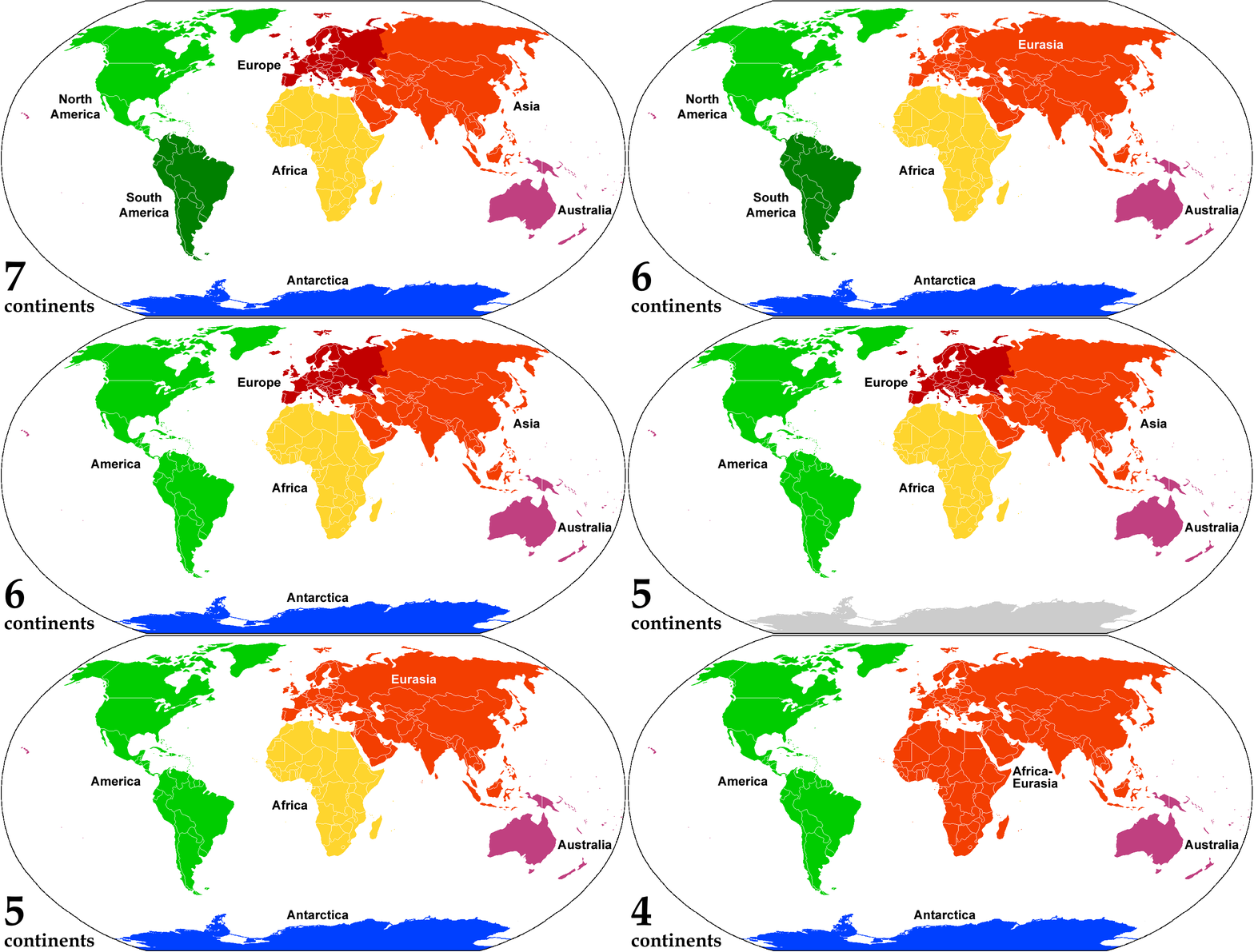
Detour: Continents
The whole thing made me look for a world map by continents. it's a topic many books were written about, and you could probably create an own reading challenge about it. here's a summary: wiki/Continent. below, an image with the various ways to distinguish continents. (and here the whole post)


7 books later and continents by population
Last week, I completed book 7 of the challenge. So far I have "visited" the continents: Europe, Asia, North America, Africa. what's missing yet is: South America, Australasia, and a "seventh continent" (either Antarctica or an own seventh setting, f.e. the sea.)

I already have the books for the next continents waiting in the bookshelf. But the whole theme now made me go and and look at a world statistic: world population by contienents.

This isn't news: the world population is now in the range of 7 billion persons. and the continent with the largest population is Asia. what i didn't fully realize, though, is the proportions of the population in relation to continents. if you put Asia in one hand, and all the other continents in the other hand, Asia still would be largest:


Here's the same statistic, only in a different type of chart: 


7 books
So looking at the world from this angle, if you want to read around the world in 7 books, you actually would have to go and look for 4 books from Asia and 1 book from Africa - and then for 2 anthologies that cover the rest of the world in their pages.

***

Update Summer 2012:  World Population, Books, and Worlds Apart

World Statistics: After arriving at this unexpected statistic, i explored this theme further in a second post, here: 1 million books published, 9 books read, and 25% non-readers: book figures from around the world

+ here's a bit more on world population, via wiki: world population

And if you are interested in world books: these are the world books i read so far: virtual world bookshelf

+ My own new book is a world book, too - written with a friend from Asia: Worl(d)s Apart: 2 friends, 2 journeys, 10 life lessons - a true story.